


The shoulder joint provides maximum range of motion for the body.This joint has a complex structure;the joint capsule of the shoulder can stretch quite strongly, thanks to which the arm can rise and produce rotational movements.This type of flexibility relaxes the ligaments.The failure of the nutritional process of the joint tissue provokes its destruction and is the basis for the development of arthrosis of the shoulder joint.
The disease mainly affects people after the age of 45 and is a pathology of the bone and cartilage tissue of the shoulder girdle.The disease is progressive, manifests itself with age, and leads to dystrophic transformations.The disease most often affects the male half of the population.Degeneration of articular cartilage and structural deformation of bone integrity trigger inflammatory processes in the synovium.Destructive changes occur almost without symptoms, up to a certain point.Painful sensations begin when the cracks in the cartilage tissue are largely filled with salt deposits.
Stages of arthrosis of the shoulder joint
The progression of shoulder joint arthrosis has three stages:
The first phase is characterized by dull pain in the shoulder area, which often worsens at night.The movements are unlimited, but some of them can cause pain when associated with the largest amplitude.In this phase, the disease is recognized by X-ray examination.The image captures the "ring symptom" characteristic of this section - the joint cavity is shaped like an ellipsoidal ring.
The second stage presents with more severe symptoms.Pain is felt in the area of the shoulder and shoulder blade - constant.A crunching sound is heard when you move your hand.Muscle spasm and muscle pain limit the range of motion and the person has difficulty moving the arm back.
A specially designed test is used.The traumatologist asks the patient to clasp his hands behind his back.If a patient suffers from a shoulder joint, this movement is almost impossible for him due to limited mobility.At this level, the x-ray shows arthrosis, which is determined by the narrowing of the joint passage, with the appearance of bone growths and thickening of the joint surface of the bones.
In some cases, muscle atrophy is noted in the shoulder area.
The third phase is accompanied by obvious deformities and constant pain.The patient can only move his hand back and forth.Raising and lowering the arm is completely impossible, the joint is deformed.There are bony prominences on the body, especially in the area where the shoulder and scapula join.The position of the hand is forced, the patient tries to keep the hand in the least painful position.
The disease rarely progresses to the final stage.
More often, there are cases when the development of pathological changes stops in the previous stages.Patients who do not stop loading the affected joint: professional athletes, physical workers, are at risk of reaching the last phase.
Causes of the disease
The main causes of pathology are determined:
- Maximum shoulder load.
- Congenital or acquired joint disorders.With this pathology, the usual load on the joint can be maximally felt.In this condition, wear and tear of the cartilage occurs.
- Metabolic disorder that causes salt deposition and failure of cartilage tissue nutrition.
- Hereditary factor.Children of parents with the disease are more prone to the development of the pathology;are in danger.
- Trauma or systematic traumatization over a period of time.In such circumstances, post-traumatic arthrosis manifests itself.
- Acute and chronic inflammatory diseases of the joints - arthritis.
- Bad habits and improper diet.
- Autoimmune or hormonal disorders.
- Metabolic disorder.
- Disorders related to the endocrine system.
- Age factor.
Symptoms of the disease
With arthrosis of the shoulder joint, the symptoms appear suddenly.Initially, a person feels discomfort when performing certain operations or after hypothermia.
The main symptoms are:
- Pain in the shoulder that occurs when moving the arm.The patient feels pain, especially in the morning and when the weather changes.The patient also feels pain when touching the shoulder.As the disease progresses, pain signals start to bother you even in a calm state.Characteristic is the spread of pain in the back.
- Movement disorder.A patient with arthrosis has difficulty performing basic tasks such as lifting the arm or performing rotational movements.Delayed treatment may cause contracture.
- Creaking and cracking sounds in the joint.The pathological phenomenon is associated with the formation of osteophytes (salt deposits).At first, the symptom is not very pronounced.However, over time, these voices become louder and even become audible to others.
- Local temperature increase, joints swell and turn red.
- Healing.When the form is advanced, bony growth appears.Arthrosis of the shoulder is accompanied by arthrosis of the subacromial joint.
Diagnosis of arthrosis of the shoulder joint
Diagnostic procedures are prescribed to determine the extent of the pathological process.Treatment is prescribed based on the results of these tests.The patient is examined by a traumatologist, and in advanced stages by a surgeon and a neurologist.The therapy program is compiled according to the instructions of the doctor - physiotherapist and massage therapist.
To establish a diagnosis, the following are prescribed:
- Blood tests.Its purpose is to identify the presence of inflammatory processes and determine their nature, for example, rheumatism.
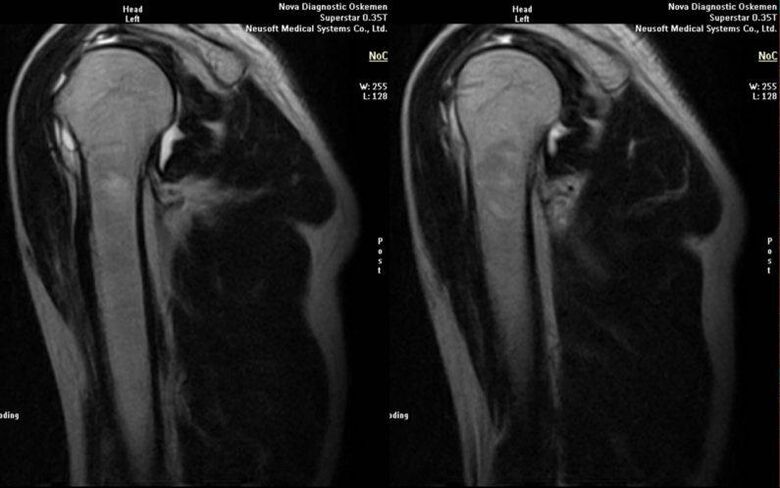
- X-ray, which makes it possible to detect joint deformation in the early stages of the disease.
- MRI.
Treatment options
Modern treatment methods include:
- conservative.
- Therapeutic practice.
- Traditional medicine.
- Surgical intervention.
Conservative treatment
Medicines used to treat arthrosis of the shoulder joint aim to stop inflammation and relieve pain.
Applicable:
- anesthetics;
- chondroprotectors;
- muscle relaxants;
- means it activates blood circulation.
External influences have a positive effect on the body:
- physiotherapy;
- laser therapy;
- cryotherapy;
- magnetotherapy.
In the first stage, ointments can be used to treat the disease.This method is particularly effective in arthrosis of the right shoulder.The use of heating agents is recommended.
Therapeutic gymnastics
Includes practice set.Every morning you should perform flexion and extension, rotation, abduction and adduction movements.
The method promotes:
- Rehabilitation of the blood circulation and metabolism of the joints.
- Increasing the flexibility of ligaments.
- Normalization of muscle activity.
The duration of the exercise should be about 10 minutes.If severe pain occurs, you should stop training for a while.A warm compress is recommended before and after training.Spicy and salty foods should be excluded from the diet during treatment.The diet should include foods that contain a high percentage of collagen.
Treatment with traditional methods
In the first stage of the disease, folk remedies are allowed;such remedies may have their desired effect at this stage.This technique should be combined with medication and therapeutic exercises.
Popular methods include:
- Using propolis mixed with pork fat.This mixture is used to wipe the sore shoulder.
- He wraps it with cabbage juice.
- Cabbage leaves smeared with honey.They are placed on inflamed areas, this helps relieve pain and reduce the inflammatory process.
Operation
In advanced cases, when fusion of bone tissue and muscle atrophy are detected, treatment is carried out surgically.During the operation, the epiphyses of the shoulder and scapula are replaced with metal prostheses.
Surgery allows the patient to regain full range of motion.
Prevention
You can protect the shoulder joint from arthrosis if you immediately eliminate the causes that provoke the destruction of the joint, and also:
- Avoid excessive stress.
- Follow the recovery period after injuries.
- Eat right.
At the first signs and pain, consult a doctor to determine the cause of the disease and stop it in time.